
| Date of Meeting | 30th August 2025 |
| Meeting Venue | Aa’s house, Indiranagar |
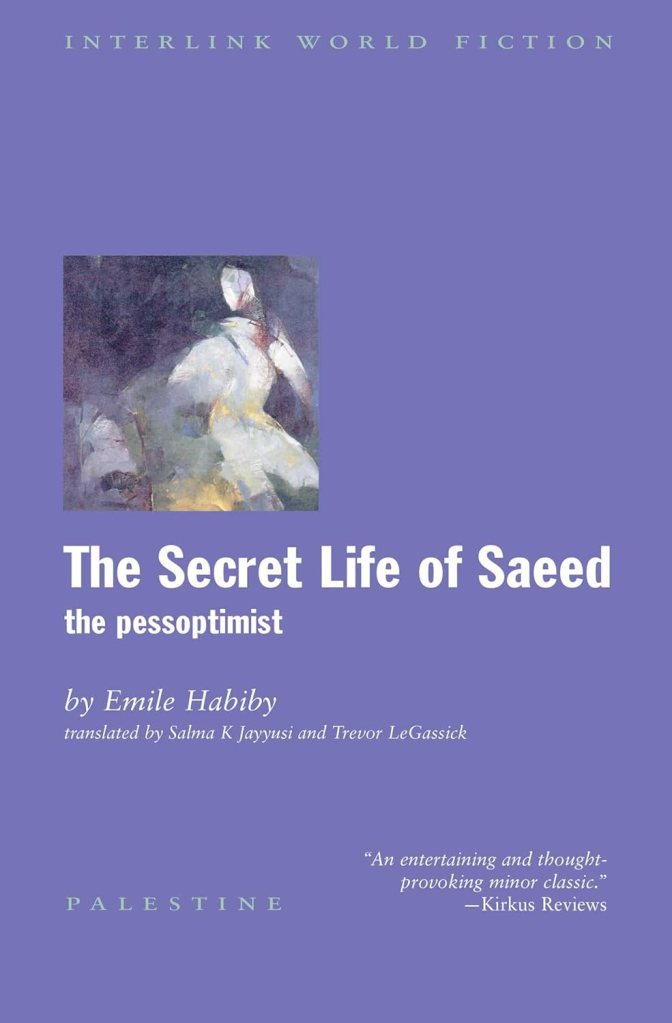
| Book | The Secret Life of Saeed the Ill-Fated Pessoptimist |
| Author | Emil Habiby |
Meeting Notes
Members found this book a bit weird, but mostly enjoyable.
This book was written from a very unusual point of view. The main character, Saeed, is someone who returns to Haifa after the Nakba and lives like a second-class citizen for the rest of his life. He is an unlikeable coward who is an informer for the Israelis, and stupid to boot. But at the end of the day, you end up having sympathy for him. We agreed that this was the point of the book; when put in such extenuating circumstances, things don’t remain so black and white.
OTHER CHARACTERS
Saeed finds love a few times: Yuaad, Baqiya, Walaa. All these characters represent some archetype of Palestinian existence, and he loses all of them as history repeats itself over and over again. Yuaad is taken away by the army. Baqiya walks “into the ocean” with her fidayeen son Walaa, and the second Yuaad again is taken away. Saeed watches helplessly as these events occur in his life, signifying that things were not changing much.
At one point, despite being a loyal spy, Saeed is sent to prison, where he is beaten and ill-treated by the guards. He converses with the man in the cell next to him, also a Saeed, who mistakes him for a fidayeen. The Other Saeed gives him strength and a new perspective. This seems to be somewhat of a turning point for our protagonist.
Saeed’s immediate boss is a “less privileged” Jewish man, and they form a sort of friendship over the years. The Big Man, or the higher-up boss, is a stand in for the State of Israel, and is often the one coercing Saeed into informing or taking a hit.
Walaa, Saeed and Baqiya’s son, represents the “hero” archetype, but one that also cannot “save” himself or others. The fidayeen cause is seen as an understandable or sympathetic route to justice, but at the end, not enough.
THE SECRET
There is a theme of “secrets” that comes up again and again; secrets that if found out, will lead to ruin. Saeed’s secret, we think, is the fact that he is an informant, sone of yet another informant. Baqiya’s secret is that her family has left her a hidden treasure with the potential to make her (and Saeed) rich. Some of us thought secret keeping can also represent Palestinians safeguarding their culture, in addition to being a means of survival.
THE STAKE
Towards the end of the book, we find Saeed imagining himself on a high stake, with nowhere to go. He is scared to fall to his death, but also to simply sit on the stake. He feels trapped and pulled in all directions – his union members and fidayeens beg him to climb down and join them, but he does not. This stake is the perfect representation of Saeed’s predicament, who is no one thing. He has no single identity or even a nation or people to really identify with. It’s a tragic (even if logical) ending that stayed with us.
THOUGHTS ON THE BOOK
The book had a fair amount of exposition, at least in a few chapters. While some of us enjoyed this, others felt like it was too on the nose. However, it was mostly beneficial, since we all had very little context about the time and place in which it was set. We did a little bit of external reading to understand the circumstances, and the introductory note by the translator was also very helpful in understanding the Arab literary landscape. In particular, it was useful to learn about how the “stupid” protagonist was unusual in Arab literature, with heroic or tragic archetypes being more common. Even so, we felt that we were not able to grasp some of the more nuanced satire in the writing. To this end, the exposition and explanations were helpful, though we still did not understand everything in it’s entirety.
We found that engaging with this book was very hard unless we took a step back and read the “story” without seeking to understand every reference. This is of course not a shortcoming of the author or the story, but of our own. We discussed doing additional reading to understand some of the stuff better.
Despite all of this, the book was pretty funny. The themes are difficult, but the satire is well done, and leaves one with a bitter sense of humour.
THE AUTHOR
The author himself was a founder of the Communist Party of Israel and was elected into the Knesset three times. This gives him a unique perspective, of fighting the enemy from within, something that does not seem possible in today’s Israel. The conflict that must have been present in his heart and mind seemed to be translated well onto the character of Saeed.
 Semi-Serious Book Club
Leave a comment