
| Date of Meeting | 27th July 2025 |
| Meeting Venue | V’s house, RR Nagar |
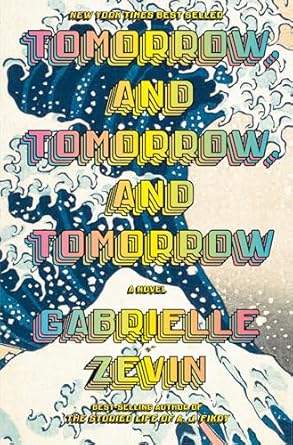
| Book | Tomorrow and Tomorrow and Tomorrow |
| Author | Gabrielle Zevin |
Meeting Discussion
Members thought the setup was very promising – the first 100 pages or so. It pulls you in with the writing style and the characters. The childhood friendship of Sam and Sadie is genuinely very sweet. However, as the story progresses, the writing seems to come off as pretentious, and the characters more and more unlikeable (and unbelievable).
FRIENDSHIP VS ROMANCE
The friendship between Sam and Sadie, we are told, is beyond love and romance and such frivolous things. But a lot of us had trouble believing this, especially because the conflicts were caused mostly by miscommunication/non confrontation. And not enough background was given (or existed) on why this friendship was special. Also, as an act of what some of us perceived as betrayal, at the end Zevin brings in an element of romance (or jealousy) from Sam anyway. This really undercut what the book was purportedly saying about friendship/partnership of this kind being a higher form of love.
IDENTITY
Identity and representation were major themes in this book, but despite that, we felt that the exploration was quite surface level, with maybe the exception of Sam’s disability. There were lots of opportunities to examine a characters pain (physical or otherwise) and how that may be shaped by identity. This was done well for Sam’s disability and arguably his Korean-ness. But other topics, like that one scene where there was almost a throuple/polyamory, or the whole plot around gay marriage, seemed half baked. It echoed liberal identity politics more than anything else. Moreover, some of us felt the book was trying to be “queer” (even if not sexuality wise) but did not succeed there either.
ZIONISM AND JEWISH IDENTITY
There were many instances in the book that felt Zionist – from Dov being Israeli (possibly ex-IDF) to Sadie winning a Hadassah prize. An event or mention involving Zionism in a book like this can be uncomfortable, but that is part of reading different authors. However, we thought the narrative was not critical enough (or at all) of the Zionist position. In fact, it seemed to not even consider it an ideology, but just another kind of Jewishness.
While Sam’s Korean side of the family is explored at length, there is no real discussion about Sadie’s Jewish family, with the exception of her grandmother, and at times her sister. This seemed a bit odd, given all the struggles Sadie goes through in her life (depression, abortion, partner death, childbirth). This is not explicitly Zionist of course, but we felt it minimizes non-Zionist Jewish representation,
After clocking the Zionist stuff, a few other things also began to seem off. We consciously tried to read critically, and try to see how Zevin’s own potentially Zionist sensibilities could come through. Some of us felt that the way the characters’ pain and trauma were depicted seemed to be steeped in a kind of self-centeredness, which could be stemming from the Zionist’s imagination of themselves as victims. (However, this is not a fully developed thought).
CHARACTERS
Sam and Sadie themselves are quite unlikeable, which is fine by itself. But they also didn’t seem to grow much as people over the course of decades.
Sam was very insecure about his looks, height, Asianness, and of course disability. All understandable, but at times it came across as a bit incel-coded. We recognize that incels are also often borne out of such insecurities, but the author does not really discuss this.
Sadie was brilliant (so very brilliant) but also definitely selfish. She acted unreasonably a number of times, and did not often take accountability for her own actions.
Much of the conflict between Sam and Sadie was over the top. Sam did not go visit Sadie’s baby? Sadie never came to visit Sam after his surgery? Neither of them talked about Dov’s abusive behaviour? Would this really happen? And the reason it does happen again and again is that the book focuses on each of these characters’ pain and their beliefs alone, and somewhat justifies their behaviour.
Marx was written as this almost perfect character, but with no depth. He felt like a moving plot device, an NPC (which was the point). He’s the one who made the business possible, who mediated between Sam and Sadie, who kept the company running. We even got his family backstory etc, but it seemed to be in service of his imminent death. The two gay employees who get married/annulled/digitally married also seemed to exist basically so that Marx could die in a contrived shoot out. The point at which Marx dies, the book loses a lot of steam.
Dov was simply horrible, and we expected him to be a sort of villain to the story, or at least a figure that is talked about in a critical way. Instead, he comes back in the end and is … fine? A strange path to take for this character, who is Israeli, probably ex-IDF (war comment), scumbag who sleeps with his student, has a wife and child in Israel, handcuffs his 20yo girlfriend to the bed in some sort of bad consent BDSM move. We were not happy with the resolution of this character.
Zoe was well liked by us. She seemed really talented, and also sensible. She broke up with Marx when she saw fit, did her music stuff, and was generally pretty chill.
GAMES
Solution was a great game for a college level student. Emily Blaster seemed more fun.
Ichigo would have been a fun game to play. Both Sides too.
The MMORPG spin off, Mapleworld, was not well received by many of us. It felt too advanced for the time (from a tech perspective). But moreover, the handling of gay marriage within it, the avowal that this game was activism in some sense, did not sit well with us.
Some of us felt the Pioneers game was too drawn out, and the great grand gesture from Sam (making a game, creating multiple avatars in it, befriending Sadie, marrying her in the game, having a child etc) was really over the top. Moreover, this part of the book was boring to many of us.
OVERALL THOUGHTS
The writing started off pretty solid and engaging, but was at times pretentious. The use of a lot big words pulled us out of the immersion the book was trying to create.
Some of the stuff, especially the gaming related stuff, seemed under researched. This is in particular with respect to gaming engines and the 90s.
The book explores the trauma of various characters by letting them escape into a fantasy realm (games). This is a solid strategy, and is explored well. Creating games could also be a creative outlet for dealing with this trauma.
The idea of “living forever” through a video game is also very interesting. And to have a game like Both Sides was doubly interesting because of this. Marx being memorialized in a game, with the context of his Macbeth speech and all, was very sweet and special.
The book seems like a mish-mash of many ideas, but when we tried to come up with a coherent statement about what this book really is, we could not. Unfortunately many of the concepts or ideas seem under developed.
Some were of the opinion that the book is about work. And finding partners to create something with. People who energize you and challenge you and fight you. Sam and Sadie have this, and thats amazing and very rare. But thats not the same as having an enduring relationship beyond love and romance and labels.
A lot of potential is there, especially in how the storytelling/form can be explored within game worlds. It works sometimes, other times it doesn’t. The book loses its way completely in the last third, but was struggling from about the halfway mark at least. It definitely did not live up to the hype, and maybe that expectation also affected our response.

 Semi-Serious Book Club
Leave a comment